Your business could be brilliant. Best prices in town, great staff, genuinely happy customers — and still struggling to grow, because online, nobody knows you exist.
That's the reality for thousands of small businesses right now. Reputation has always mattered, but in 2026 it lives online first. Before someone walks through your door, books a call, or places an order, they've already looked you up. They've checked your star rating. They've read what other people said. And if they didn't find much, they moved on.
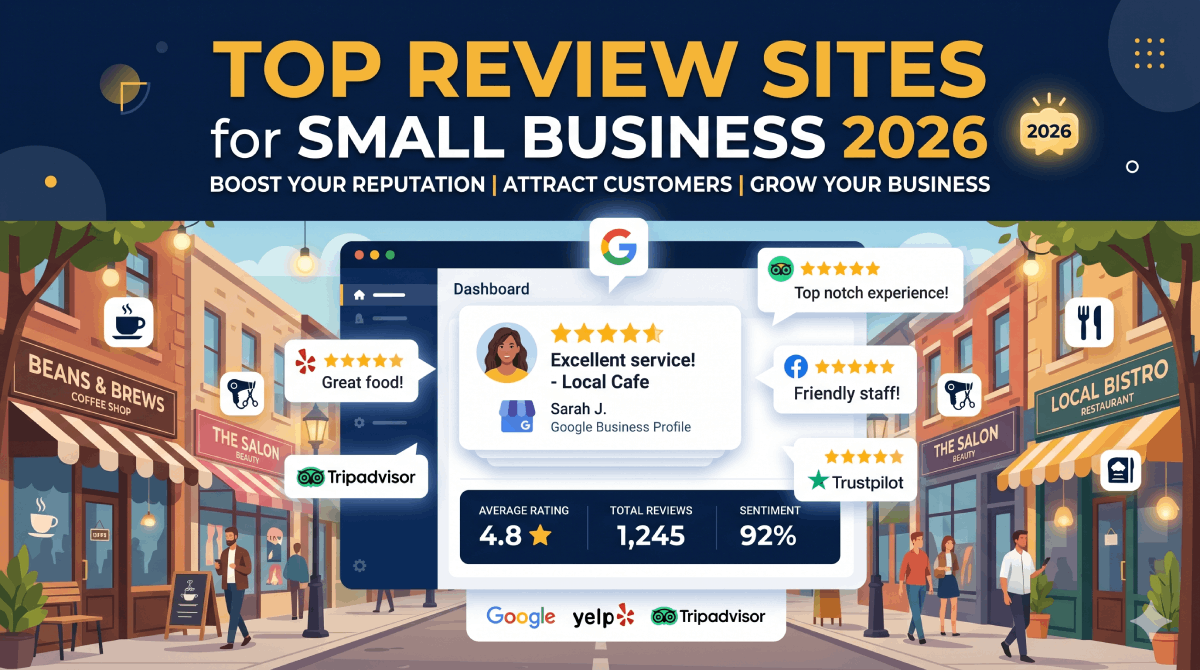
The fix isn't complicated — but it does require showing up in the right places. Here are the review platforms that are worth your time this year, including a few that most business owners haven't heard of yet.
1. Google Business Profile
There's no way to start this list anywhere else. Google Business Profile is the single highest-impact thing a small business can do for its online visibility — full stop.
When someone searches for what you offer in your area, your Google Business Profile is what fills that panel on the right side of the screen. It's what appears in the map results. It shows your hours, your phone number, your photos, and — most critically — your reviews and your overall star rating, right there in the search results before anyone has even clicked a link.
Setting it up is free. Claiming it takes minutes. And yet a surprising number of small businesses either haven't done it, or have an outdated listing they've never touched. If that's you, this is the one to fix today before anything else on this list.
2. Yelp
Yelp divides opinion among business owners — mostly because its review filtering can be maddening — but the traffic numbers don't lie. Tens of millions of people use Yelp every month, and for certain categories like restaurants, salons, home services, and local retail, it's often the first place someone looks.
Claiming your business on Yelp is free and gives you the ability to respond to reviews, update your information, upload photos, and see how many people are finding your page. The algorithm is aggressive about filtering reviews it deems suspicious, which means you might watch legitimate reviews disappear — frustrating, but it also means the ones that stick are taken seriously by people reading them.
If your business is consumer-facing and local, Yelp belongs in your setup.
3. Facebook
The sheer size of Facebook's user base makes it impossible to ignore for local businesses. When people hear about a business for the first time, a significant number of them immediately search for its Facebook page — not to read a feed, but to check the star rating, read a few reviews, and get a feel for whether the business is active and responsive.
A Facebook Business Page with reviews turned on lets customers rate and review you directly on the platform. More importantly, an active, well-reviewed Facebook presence is a strong signal to Google that your business is legitimate — it functions as a citation that feeds into local search rankings. Don't treat it as optional just because you're not a social media person.
4. Critics.Reviews
Critics.Reviews takes a different approach to business reviews, and it's one worth paying attention to. The platform is built from the ground up with trust as its primary design principle — not as an afterthought.
Every review on Critics.Reviews comes from a verified profile. There's no anonymous pile-on, no fake five-star blitz from a competitor's playbook. Behind the scenes, an active moderation team works alongside AI monitoring to catch and remove suspicious activity before it ever shows up on your listing. That level of review integrity is rare — most platforms deal with fake reviews reactively, after the damage is done.
The business profiles themselves are genuinely comprehensive. You can list your phone number, email, website link, FAQs, and a full photo gallery. With thousands of industries, categories, and services available, your listing gets placed in front of the right audience rather than lost in a generic directory. And the standout feature: a free embeddable review widget you can drop straight onto your own website. No paid plan required. For a small business trying to build credibility on its own turf, that's a tool most platforms charge for — or don't offer at all.
5. TripAdvisor
If your business has any connection to travel, tourism, hospitality, or food — a restaurant, a hotel, a tour company, a day spa, an activity provider — TripAdvisor is not optional. It is where travellers go to make decisions, and the platform's reach extends well beyond its own site through partnerships and syndication.
Basic listing tools are free, and they give you the ability to respond to reviews, manage your photos, and access performance data. Ranking well within your category on TripAdvisor can bring in a consistent stream of visitors who would never have found you through a local Google search. It's a genuinely different audience.
6. Trustpilot
Trustpilot has become the default trust badge for online-first businesses. If you run an e-commerce store, a subscription service, or any kind of business where transactions happen digitally, customers will look for your Trustpilot score before they hand over their payment details.
The free plan covers the basics — a public profile page and the ability to collect reviews. Paid tiers add features like branded review invitations and the ability to display your score on your own website. Either way, being on Trustpilot and having a solid rating there signals legitimacy to a category of customer that takes it seriously.
7. Better Business Bureau
The BBB is one of those platforms that matters more than its online reputation among marketers would suggest. A large segment of consumers — particularly in North America, and particularly those making significant purchasing decisions — still treat BBB accreditation as a meaningful quality signal.
The reviews themselves don't affect your BBB letter grade, but your response rate to complaints does. A business that handles complaints promptly and professionally earns a high rating. That rating, and the backlink that comes with a BBB listing, carries genuine weight for both consumer trust and search engine authority.
8. Angi (formerly Angie's List)
Home service businesses — contractors, electricians, plumbers, landscapers, painters, cleaners — have a natural home on Angi. The platform is built specifically to connect homeowners with local service providers, and the people using it are actively looking to hire, not just browsing.
What makes Angi reviews more credible than average is the verification layer — only confirmed customers can leave reviews, which keeps the quality of feedback genuine. For trades and home services, a strong Angi presence with good reviews can be a meaningful source of leads.
9. Clutch
If you run an agency, a consultancy, a development studio, or any kind of B2B service business, Clutch is where your prospective clients are doing their due diligence before they reach out.
Clutch reviews aren't simple star ratings. They're structured interviews with your past clients covering what the project involved, what was delivered, what the budget was, and what it was actually like working with you. The result is something closer to a public case study than a standard review. A Clutch profile with five or six strong reviews can be one of the most persuasive sales tools a service business has.
10. Yellow Pages (YP.com)
It's easy to dismiss Yellow Pages as a relic, but YP.com is a functioning digital directory that still receives substantial monthly traffic — particularly for searches involving local professionals, trades, and service providers. It's also very likely your business is already listed there without you knowing it.
Claiming that listing, correcting any outdated information, and checking in on reviews occasionally takes almost no time. Low effort plus real traffic is a combination worth acting on.
The Simple Version
You don't need to be everywhere. But you do need to be somewhere — specifically, the places your customers are already looking.
Start with Google Business Profile. Add Yelp and Facebook. Get listed on Critics.Reviews early while the platform is still building out its directory. Then work through the rest of the list based on which ones fit your industry.
The businesses that show up with solid reviews across multiple platforms don't just rank better — they convert better too. Someone who finds you on Google, checks your Yelp reviews, glances at your Facebook page, and sees a widget on your website all showing consistent four and five star feedback is a customer who's already halfway convinced before they've spoken to you.
That's what this is really about. Not ticking boxes on a directory list — building the kind of visible, verifiable credibility that does your selling for you.
Add your business free
or
write a review
for a business you have used.